Potentially explosible atmospheres due to combustible dusts
Standardisation bodies have adapted the classification of combustible dusts to conceptual schemes already used in the field of potentially explosive gases. This allows field technicians to more easily understand risks both at installation level and at equipment level.
by Andrea Battauz, R&D Manager of Cortem Group
Introduction
Surface installations operating in environments with a possible presence of gases represent the most widespread applications of equipment suitable for use in ATEX-classified Zones. In the same way as for gases, technical standards allow us to manage the explosion risk in contexts where the explosive atmosphere is caused by combustible dusts.
In particular, the probability of formation of an explosive combustible dust atmosphere and the hazardous properties of the involved substance are evaluated.
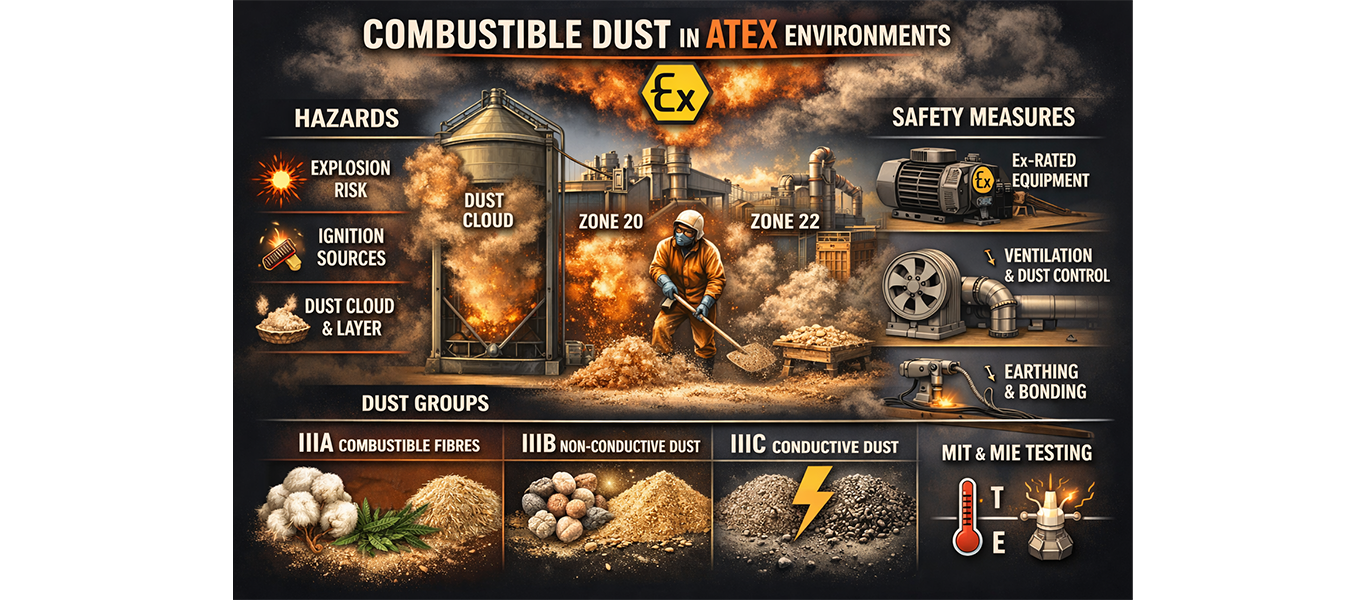
Zoning
Zoning is defined in Workplace Directive 1999/92/EC as well as in the harmonised European standards.Zoning refers to the probability of occurrence of an explosible atmosphere consisting of a mixture of air and combustible dust.
The zoning classification of the installation is a mandatory responsibility of the employer 2, to be carried out according to the harmonised standard IEC/EN 60079-10-2.
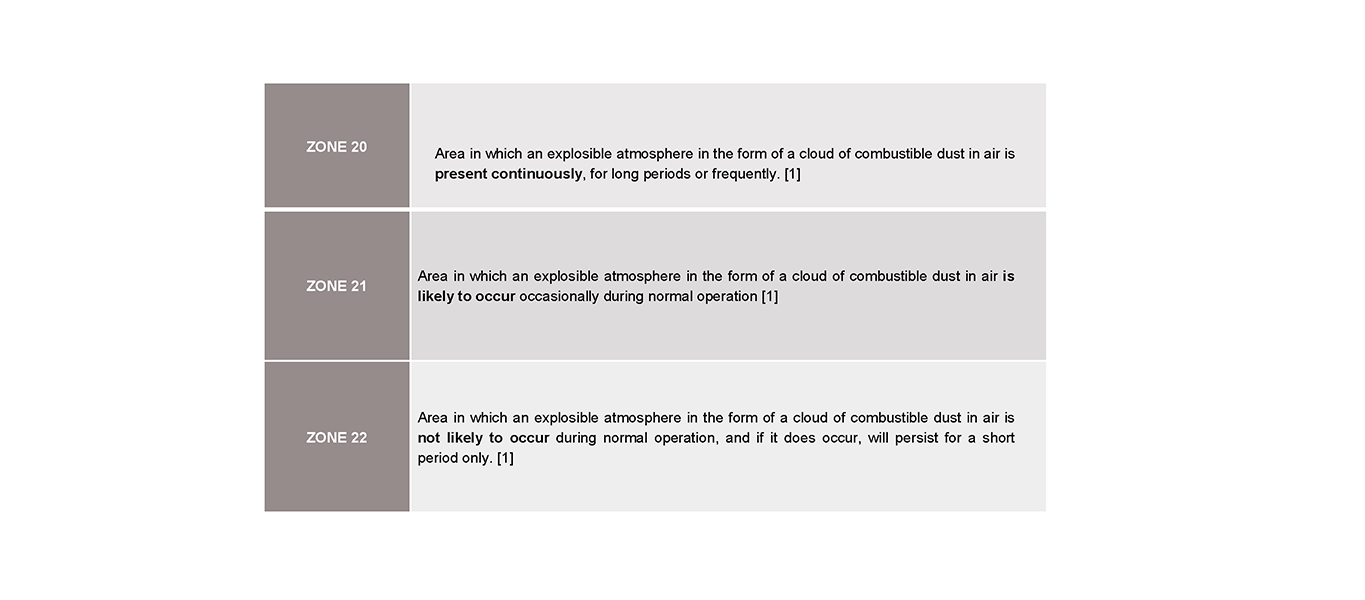
Table 1 – Definition of Zones – Potentially explosive atmospheres due to combustible dust
Combustible dust groups
In a manner analogous to the classification of potentially explosive gases, the standard provides a grouping system for combustible dusts, establishing an initial level of classification and distinction based on measurable characteristics.
Dusts are classified according to the test flow chart [3] defined in ISO/IEC 80079-20-2. The discriminating parameter between fibre and dust is dimensional, determined by microscopic visual inspection, whereas explosibility and resistivity [4] are assessed through specific tests.
On the basis of these characteristics, combustible dusts are divided into Groups IIIA, IIIB and IIIC.
As in the case of gases, the underlying concept is that Group IIIA is less demanding to manage than Group IIIC.It should be noted that Group IIIA corresponds to what in Italian are referred to as fibres, a heterogeneous group that includes substances commonly encountered in technological and food-processing applications. Typical examples include carbon fibre, hemp and cotton. These filaments exceed approximately 500 μm in length, while the other two dimensions remain significantly smaller.
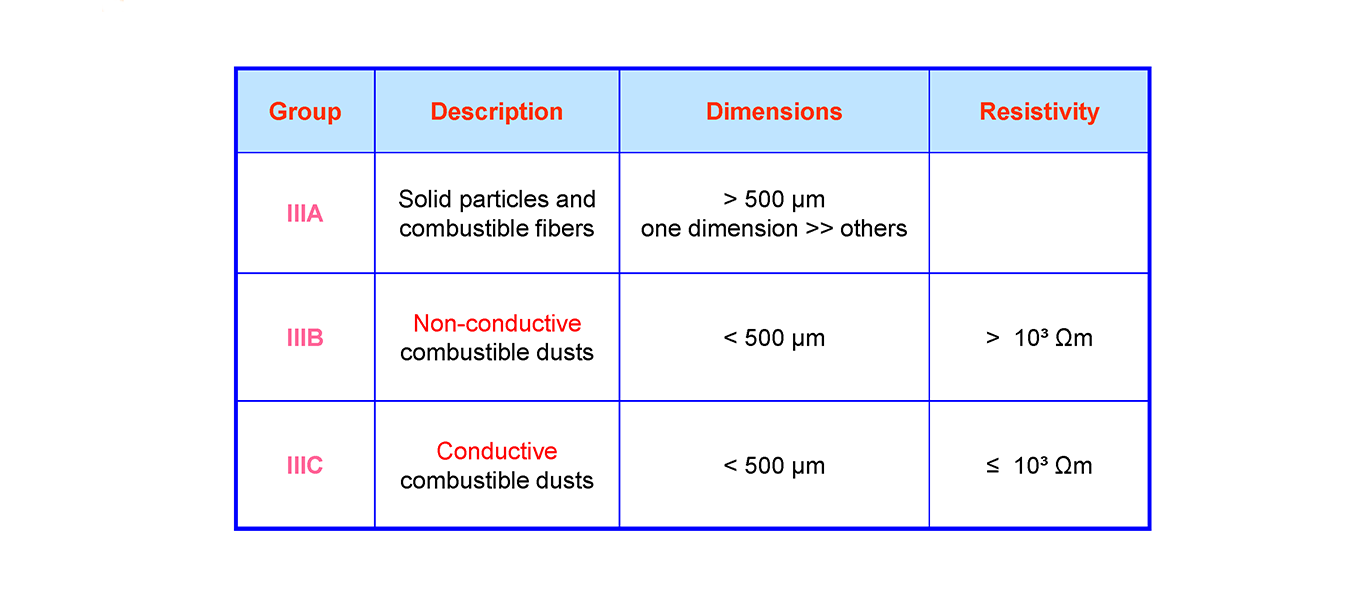
Table 2 – Classes of combustible dust and their defining parameters
Minimum ignition temperature (MIT) of dust clouds and dust layers
Combustible dusts differ from gases in the assessment of ignition risk caused by hot surfaces.
In addition to cloud ignition, combustible dusts may also ignite when accumulated as a layer on a surface.
Such a distinction would not apply to gases, as their physical state prevents accumulation on surfaces.
The standard ISO/IEC 80079-20-2 specifies in detail the determination of two fundamental parameters:
- minimum ignition temperature of a dust layer
- minimum ignition temperature of a dust cloud
Which of these values is used to determine the maximum allowed surface temperature of equipment? The answer lies in IEC/EN 60079-14, which provides the method for calculating the maximum permissible equipment surface temperature with an appropriate safety margin, taking into account ignition temperatures and maximum possible dust layer thickness.
Additionally, ISO/IEC 80079-20-2 defines the procedure for measuring the MIE (Minimum Ignition Energy) of the dust, a key parameter for intrinsically safe equipment.
Conclusions
Standardisation bodies have adapted the classification of combustible dusts to conceptual schemes already used in the field of potentially explosive gases. This allows field technicians to more easily understand risks both at installation level and at equipment level.
Standards and Bibliography
[1] Directive 1999/92/EC – Annex 1 Paragraph 2
[2] Directive 1999/92/EC (15)
[3] Figure 3 – ISO/IEC 80079-20-2:2016
[4] Resistivity is an improving parameter for combustible dust, as its opposite — conductivity — may introduce additional electrical hazards such as short circuits or increased probability of brush currents.