


High-Performance Industrial Coatings: Compliance and Durability in C4 and C5 Environments
From ISO 12944 requirements to advanced testing: Cortem solutions for corrosion protection in extreme atmospheres
Descubrir
Las sustancias y los materiales producidos y tratados en las plantas petroquímicas entrañan un riesgo constante para el medio ambiente y para las personas que trabajan en ellas.
El petróleo y el gas, transformados en la industria petroquímica, son intrínsecamente combustibles, de manera que el riego de explosión e incendio en estos lugares es muy alto.
La distinción entre «procesos petroquímicos» y «procesos de refinación» radica en el destino de los productos obtenidos: los productos obtenidos de la refinación del crudo van dirigidos a la producción de energía (es decir, se emplean como combustibles), mientras que los productos de la industria petroquímica se utilizan como materiales en otros procesos posteriores.
El petróleo y el gas se extraen, transportan, almacenan y refinan en condiciones sumamente duras.
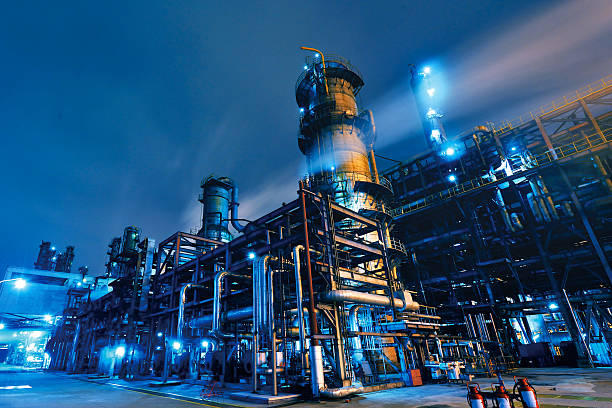
Los productos antideflagrantes so solo deben ofrecer la máxima fiabilidad y elevadas prestaciones, sino que también han de resistir el calor, el frío, la humedad, las vibraciones y los golpes. Día tras día, deben seguir funcionando con requisitos de mantenimiento mínimos.
La industria del petróleo y del gas se divide en varios segmentos: on-shore, off-shore, transporte y almacenamiento, transformación de gas y GNL.
Project Agreement provides for the supply of Lighting Fixture, Junction Box & Socket Outlet
Cortem Group has supplied 7,751 pieces of the new LIFEX series LED lighting fixtures.
The EVL-70 series LED lighting fixtures replace mercury vapour lamps
Khurais project in Saudi Arabia, Zohr Gas Field in Egypt and Al-Zour in Kuwait.
How we have solved the need for efficient and quality emergency lighting, reducing energy and maintenance costs.
From ISO 12944 requirements to advanced testing: Cortem solutions for corrosion protection in extreme atmospheres
The protection method by enclosures “t” is based on a simple yet effective concept: providing electrical equipment with an enclosure that prevents the ingress of combustible dust and employing means to limit the external surface temperature.
With regard to explosion hazards due to the presence of combustible dusts, the correct matching between plant location and equipment follows the same logical approach used for potentially explosive gases. This symmetry is intentional, as it facilitates designers and installers in the selection and installation of the appropriate equipment. Let's see the choice of equipment based on EPL, dust group and maximum surface temperature.
Standardisation bodies have adapted the classification of combustible dusts to conceptual schemes already used in the field of potentially explosive gases. This allows field technicians to more easily understand risks both at installation level and at equipment level.
Today, polyester-based powder coatings provide high corrosion resistance even in harsh and extreme ambient temperature conditions. Their application process—and, of course, their formulation—is of great importance
Although corrosion is not a primary focus of the ATEX Directive, it remains a critical factor for the safety and, over time, this has led to the widespread adoption of aluminium–silicon alloys and stainless steels as the materials of choice for manufacturers operating in this highly demanding industrial sector.
An increasingly frequent case for the construction of Zone 1 switchboards is the use of Ex eb enclosures for the integration of electromechanical components and/or electronic interfaces compliant with and with EPL Gb certification.
The presence of pipes without seals can lead to the propagation of the explosion and, with it, the increase in pressure from the initial equipment to those connected to it. The regulation offers us a series of tools to limit the occurrence of pressure-piling phenomena, for example by sealing the exits of the enclosures, and by limiting the occupation of the sections inside them.
To save energy in lighting systems located in areas at risk of potentially explosive atmospheres, it is possible to decide to intervene by automatically switching off the devices after a certain number of hours or, where possible, by reducing the luminous flux at the outlet thanks to the use of floodlights, linear lighting fixtures and high bays with several types of dimming.
Cost- effective device solutions are increasingly widespread. In addition to the economic advantages, limited breathing devices can also boast improved performances such as less weight, better luminous efficiency, higher heat dissipation.
In intrinsically safe systems, associated equipment plays a key role in the safety of the system. Their positioning can be foreseen outside the hazardous area or, alternatively, in explosion-proof enclosures that can provide them with adequate protection for installation in Zone 1.
In installations with areas classified as being at risk of explosive atmospheres, the 'Ex i' is the protection mode with the most certificates active on the IECEx website. The intrinsically safe method of protection is based on the principle of eliminating the ignition by limiting the energy in the danger zone.
Cold flow in cables is the movement of the cable sheath/filler under compressive forces created by moving gaskets in the cable glands, where the compressive force applied by the gasket is greater than the resistance of the cable sheath/filler to deformation.
Combined protection methods represent a fundamental approach to guarantee the safety of electrical equipment in areas classified for the presence of potentially explosive atmospheres. Their application makes it possible to satisfy different construction and operational needs, combining the advantages of the various protection methods available.
Metallic materials are not subject to the typical problems of plastic materials such as aging and resistance to UV rays, but rather can become ignition sources themselves. This is why the legislation pays particular attention to the parts that act as housing.
The main materials of non-metallic origin in electrical equipment are plastic and elastomeric materials. Their enemies are aging, ultraviolet rays and electrostatic charges
In this article, we will delve into the connection of 'Ex db' and 'Ex eb' electric motors with 'Ex eb' junction boxes to the power line using electrical connection accessories, i.e. adapters, sealing fittings, cable glands and flexible tubes. Being able to use an Ex-eb cable gland is not at all negligible from an economic point of view. The time saving during installation compared to installing a sealing fitting or an Ex-db cable gland is considerable.
Increased safety electric motors or flameproof electric motors with increased safety connection box have been on the market for many years. Let's see the connection of Ex- db electric motors with Ex- db connection box to the power line by using some examples of system applications
In the design and use of electrical devices we must manage conductive parts with different electrical potential, with even very high voltage differences. The risk of formation of electric arcs in the air and creeping currents on the surface of the insulation material must be considered. To limit these phenomena, during the design phase we intervene on the distances between exposed conductive parts.
There are a series of physical phenomena which concern all electrical devices in general, but which assume great importance in equipment for areas classified as hazardous for potentially explosive atmospheres. One of these phenomena is called "breathing".
In a world where the installation speed, the overall site security and the installation and maintenance costs are increasingly important, the use of specific connectors as FlowEx series can find wide application.
In Europe, the process of harmonization of regulations has opened a new phase in technological development and, to all intents and purposes, can be considered a success of the process of integration of the European Union. The birth of the EEC, the establishment of the CENELEC and CEN technical committees, the first ATEX 94/9/EC regulation and then the new ATEX 2014/34/EU regulation... let's retrace together the last steps that led to the present day have a harmonized regulatory framework at Eu
Often the meaning of the supplementary letter is little known, misunderstood and misinterpreted. Not understanding the difference between component and equipment or thinking that a certificate with the final "X" is a sort of B-series certificate with strong limitations on the use of the equipment is completely anachronistic today.
In the United States, the path that led to the development of equipment suitable for use in areas at risk of explosion has followed an almost parallel path to Europe, addressing the issue first in the mining industry and then extending it to electrical devices in the NEC. The use of still current techniques demonstrates how much the more traditional methods of protection can boast a history of reliability and safety spanning more than a century.
The systems are mainly divided into systems with metal protective conduits and cable systems. The various devices require cable entries suitable for the type of protection used. The type of cable entry may appear to be a mere theoretical argument, but it has a decisive impact on the safety level of the system.
In areas at risk of explosive atmospheres, systems with electrical cable installations are nowadays a valid alternative to traditional systems with conduits systems. Their diffusion has been driven by the increasing presence of increased safety equipment such as junction boxes or 'Ex eb ' lighting fixtures, which implicitly lead to the need for sections of the system with cable installation.
In sites where there is a risk of the formation of an explosive atmosphere, we often find the electrical conduit in a metal protective tube (also called conduit conduit). Although it has recently been joined by more versatile armored and non-armored cable systems, with cable gland entry, its use is recommended in plants where production or use and maintenance activities can present dangerous situations for the integrity of the cables.
Today we define the methods of protection as techniques that are made available to us by harmonized standards, to satisfy the Essential Health and Safety Requirements. It appears clear how the first decades of the twentieth century proved to be fundamental for the development of the techniques underlying the current methods of protection.
Sealing fittings are often considered only as secondary or minor components, but the safety of an installation with metal electrical conduits and related explosion-proof enclosures depends on them. The main function of a conduit sealing fitting is to prevent the propagation of an explosion from the inside of the ‘Ex d’ flameproof enclosure to the outside.
Nowadays, the classification in an area at risk of explosion concerns many sectors of the industry and includes the use of the most diverse equipment. This great variety of devices and applications must not make us forget that the origin of explosion risk containment techniques lies down there, in those dark mines where it all began.
Explosion-proof joints are one of the basic aspects of the protection offered by an equipment or an explosion-proof enclosure. For this reason, understanding their function is a prerequisite for the correct use and the proper maintenance of all electrical devices that adopt this type of protection.
The 'Ex d' type of protection, now referred to as 'Ex db', is based on a simple theoretical concept: containment by means of a sturdy casing and flame retardancy. Its success is due to this simplicity, it is in fact one of the first methods of protection developed in the mining industry and still today it is one of the most widespread in areas classified for potentially explosive atmospheres.
A fundamental principle of the ATEX Directive 2014/34 / EU, shared with the other Union directives, is the limitation of legislative harmonization to essential health and safety requirements of public interest. Within this legislative harmonization, a role of primary importance is played by the harmonized technical legislation and the concept of the state of the art. The ATEX Directive refers to this concept as a requirement requested of manufacturers.
ATEX device's manufacturers use different types of protection to achieve a certain EPL. These methods of protection are constantly evolving both technical and regulatory. In any case, the most used are those that have established themselves historically.
Each equipment that must be installed in an ATEX classified area must have a certain level of protection, indicated in the legislation with the acronym EPL (Equipment protection Level). The level of protection is obtained by applying technical regulations that define the protection methods. There are many ways of protection, some have a historical origin, others are more recent...
Protection during the loading and unloading operations of liquids and dry inert material
A correct earthing system must comply with all safety requirements and carry out the standard procedure.
"Obstacles to flight": standards and criteria for the positioning of equipment for their correct identification