The NEC Code, Groups and Temperature Classes
A comparison of the North American and European classification systems for hazardous areas.
by Andrea Battauz, Senior Mechanical Design Engineer of Cortem Group
Introduction
Following on from last month’s article [1], this article takes a closer look at the similarities between the American NEC system and the EN/IEC standards that are more familiar to us, which are associated with the ATEX Directive and the IECEx Scheme, respectively.
In particular, unlike the European system, which divides an installation site into hazardous areas classified by Zones, the NEC 500 defines these areas as Divisions, while the type of hazardous substance is identified by its CLASS (gas, dust or fibre).
However, the hazard posed by a substance cannot be fully described by its CLASS alone. The concepts of gas group and temperature class must therefore also be introduced.
Groups
Within each CLASS, NEC 500 further classifies the hazard posed by the substance into GROUPS.
For CLASS I, which covers gaseous substances, GROUPS A, B, C and D are defined.
For European readers, these GROUPS can be understood by comparing them with gas SUBGROUPS IIA, IIB and IIC, as shown in Table 1.
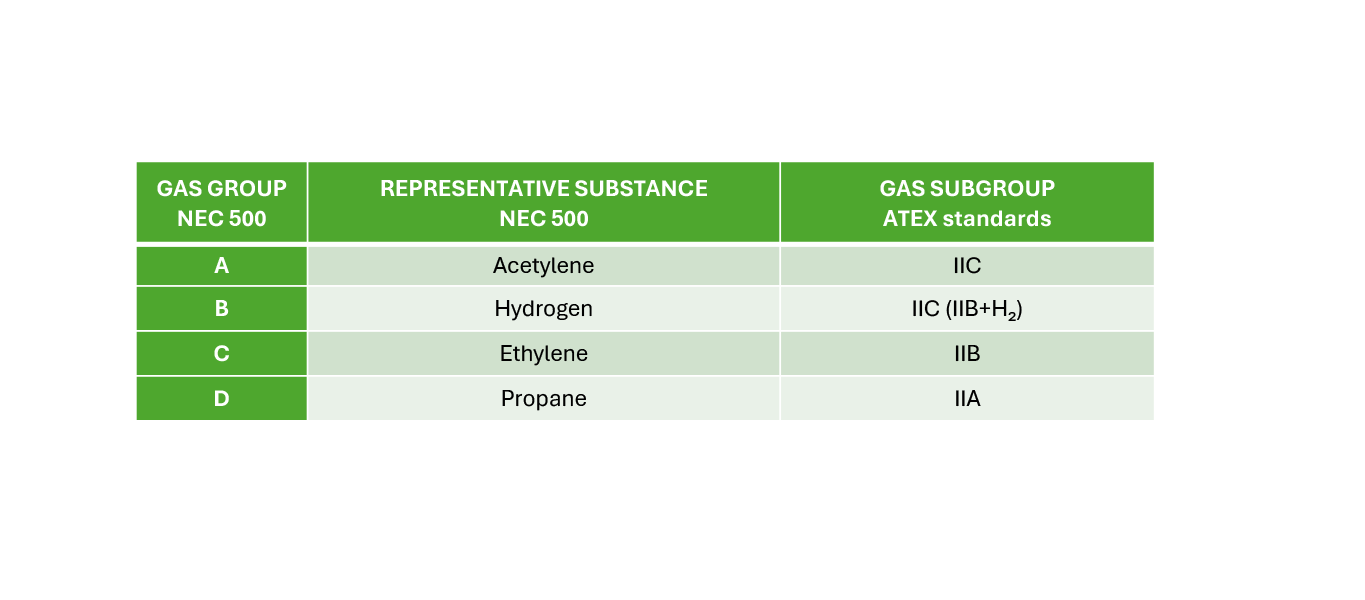
Table 1 – Comparison between CLASS I gas GROUPS (NEC 500) and gas SUBGROUPS (ATEX)
Since explosion protection methods are based on the same principles – primarily containment, as in the American explosionproof and EN/IEC flameproof types [2], or energy limitation, as in intrinsic safety – the hazards posed by gases are assessed using the same parameters.
It is worth noting that NEC 500 divides EN/IEC Group IIC into Groups A and B. A similar approach can also be found in EN/IEC flameproof enclosures. In fact, the same flamepaths used for Group IIB may also be used in hydrogen atmospheres, provided that this is validated by testing during the product certification process (the marking on the nameplate then indicates Group IIB+H₂).
It should be remembered that the GAS GROUP is a key factor in the design of flameproof enclosures, whether under NEC 500 or the EN/IEC schemes. Group IIC gases, corresponding to Groups A and B under NEC 500, tend to escape through flamepaths during an explosion and therefore require more stringent restrictions on the types of joints permitted [3].
CLASS II is further divided into Groups E, F and G, covering conductive and non-conductive dusts. The fibres in CLASS III are not further subdivided.
The temperature classes
A second risk factor in the ignition of a gas explosion is the temperature generated by the heat produced by equipment during operation. These temperatures must remain below the auto-ignition temperature (AIT) of the gases present.
This concept is also addressed by EN/IEC standards. However, the historical NEC 500 system provides for a further subdivision into temperature sub-classes, which is not found in either the European system or its international extension.
For example, temperature class T3 is subdivided into T3, T3A, T3B and T3C.
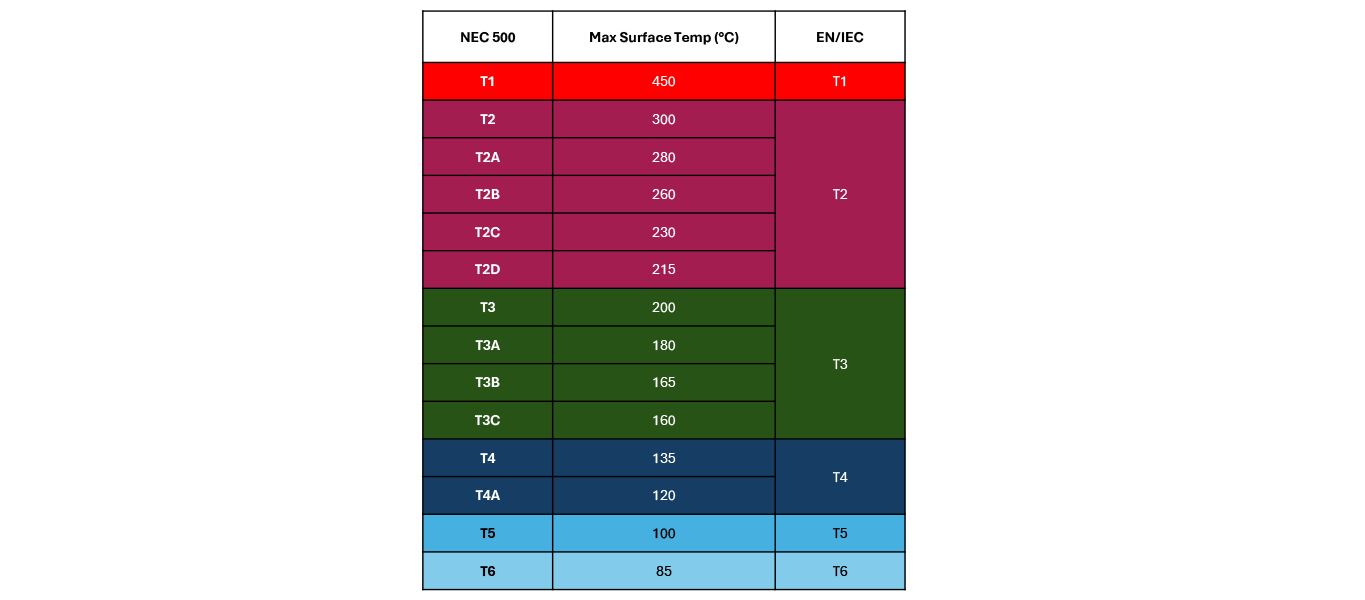
Table 2 – Comparison of temperature classes
Conclusions
As discussed in the previous article, the requirements of NEC 500 can be understood by drawing comparisons with EN/IEC standards. Although differences exist in the detailed classification of substance groups and temperature classes, the standards mentioned are based on the same fundamental concepts.
Notes and References
[1] The NEC Code and Class/Division Classification
[2] These two terms are often used to distinguish enclosures certified to UL 1203 (explosionproof) from those certified to EN/IEC 60079-1 (flameproof).
[3] Under the EN/IEC scheme, threaded and cylindrical joints are typically permitted.